September 17, 2014 (Holy Day Prep 5775)

The Hebrew translation of the phrase, “I am sorry,” is selicha.  It is a concept that weighs heavy on our minds during this season.

As we begin to prepare ourselves for the High Holy Days, it is important to take time to consider the actions and behaviors of this past year for which we are sorry.  This process will officially begin on Friday night at a special service called,  Selichot (which means “apologies”).  Through special songs and meditations, we will formally mark the beginning of the penitential season at Houston Congregation for Reform Judaism.

Please join us this Friday Night, September 19  as Dr. Jane Becker and Cantor Vadim Tunitsky help us begin our spiritual preparations by teaching us a number of central melodies for this season.

Whether it is through a special worship service or through private moments of introspective contemplation, this is the time to begin to examine our behaviors over the past year and prepare our spirits for the Days of Awe.   I pray that the ensuing weeks of personal reflection and introspection will be productive and cathartic for each of us.


Shanah Tovah — Steve

September 10, 2014–Blessed in Coming and Going

I was only a cub scout for a few years, and of all the things I learned as a scout, the following tidbit of wisdom has remained with me every time I go camping. Every time we went on an outing in the wilderness our troop leader would remind us that, “We should always leave things better than the way we found it.”

In our Torah portion this week, our ancestors receive a very similar message as they conclude their wanderings in the wilderness. In Deuteronomy 28:6, our ancestors are blessed with the following words, “Blessed may you be in your comings and blessed may you be in your goings.”

In our daily lives, these two versions of the same message remain central in our efforts to maintain a sense of balance and respect between us and the world around us. If we can try to enter situations with a mindset of entering and leaving situations with the blessings of our hearts and minds, we ultimately leave a positive footprint in the world.

As this week continues to unfold, let us consider some of the many ways that we can be a blessing in our homes or our places of work; with friends or strangers; to ourselves and to the world into which we have been born.

L’Shalom–Steve

September 3, 2014–Amalek and Evil

In this week’s Torah portion, we read the story of the Amalekite attack on the Israelites as they wandered in the dessert (Deuteronomy 25:17-19). This biblical passage describes a brutal ruthless attack on the weakest and most vulnerable of the Israelites. Attacking the children and the elders who were stationed at the back of the camp, the Amalekites demonstrated unabashed cruelty and cowardice. The brutality of this attack evokes God’s wrath, and in response to Amalek’s cruelty, God instructs the Israelites to wipe out the Amalekites forever.

Subsequently, in Jewish life throughout the ages the nation of Amalek became the archetype for all of the evil enemies who have risen against our people. All of our enemies, from Haman to Hitler, have been associated with Amalek.

This ancient story is hauntingly contemporary as we witness the rampages of the Islamic State as they brutally ravage large areas in Iraq and Syria. Their tactics are cruel and violent, and they embody everything we associate with evil.

While a political response to this horrible group may not yet be fully established in the United States, our Torah portion this week helps us put this group into a context that transcends time and space. Every generation sadly faces Amaleks in various forms, and as we read our Torah portion this week while gruesome violence rages around the world we are reminded that evil has yet to be blotted out from our midst.

L’Shalom–Steve

Global Tensions Remind Us of Local Responsibilities

Interfaith relations in the United States have experienced a summer of trial and tribulation. In the context of Jewish relations with Christians and Muslims, these stresses have been relentless and difficult.

Well before the war in Gaza, our relationship with the Presbyterian Church suffered a major blow as the result of the Church’s decision to divest from a number of major companies that did business in Israel. This tension was (and still is) extremely painful, as Jews and Presbyterians have a long history of working hand in hand in the United States and abroad. In response to the divestment decision, Rabbi Rick Jacobs, president of the Union for Reform Judaism, issued a statement on behalf of the Reform Jewish community which contained the following commitment:

“We will continue to work with local Presbyterian congregations, many of which we know do not support this [boycott] and with which our congregations have forged important alliances to further the values that we jointly hold as core to our desire for a better world for all peoples.”

In essence, Rabbi Jacobs is saying that despite our differences and despite these newly formed tensions generated by the boycott, the Reform Jewish community is committed to nurturing a relationship that promotes goodness and cooperation in the world. This is the mindset that we must embrace and cultivate with all faith communities.

In the wake of the war in Gaza, religious and political tensions have placed strains between Jews and Muslims as well as others. Yet, throughout the summer our congregation refused to allow these tensions to deter us from working together. We hosted an Iftar (Muslim break-the-fast) and engaged with a number of mosques throughout the crisis. We hosted 50 teens from a regional peace camp for a Friday night dinner and Sabbath Service, and we redoubled our efforts to embrace our differences despite the tension and inner pain.

In the spirit of building bridges of understanding, HCRJ will be hosting a one of a kind interfaith program on Thursday, September 11. Join us for an evening of entertainment and dialogue as we seek to strengthen our connections with a wide variety of faiths through an award winning one-woman show called The God Box (see page 6 for details). Members of the Christian, Muslim, Hindu, Sikh and Bahia communities have been invited to join us for this event as we use this humorous and dramatic program to stimulate conversations about God, faith and tolerance.

These summer tensions, uncomfortable as they may be, have served to remind us that we cannot allow global madness to sabotage our relationships with local faith communities. Taking our lead from Rabbi Jacobs, we must recognize the value and importance of working together despite our differences.

August 27, 2014 –Elul (40 Days)

Today is the first day of the Hebrew month of Elul. Today is a day of incredible significance to the Jewish people in the process of atonement, because from this day forth, we embark upon a 40 day journey which will lead us through Yom Kippur.

This 40 day process parallels many of the important events in our lives and our heritage which also involve the span of 40 days, 40 weeks or 40 years. Consider some of the following:

• 40 days of the flood in the story of Noah;
• 40 days of waiting while Moses was receiving Torah from God on Mount Sinai
• 40 years of wandering in the wilderness after our Exodus from Egypt;
• 40 weeks of pregnancy;
• 40 days for spiritual preparation from the first day of the Hebrew month of Elul (which is the month which immediately precedes the beginning of the Jewish New Year) until Yom Kippur.

In each of these circumstances, the number 40 plays a major role in the human transition from chaos to renewal. In the story of Noah and the flood, the world was born again after 40 days. In the story of Moses and the receiving of Torah, 40 days of waiting results in the Laws that would forever shape the Jewish experience. In the case of 40 years of wandering, our people found renewal as they entered the Promised Land. In the case of childbirth, 40 weeks of gestation results in the promise of new hopes and dreams, as renewal is the gift that is realized with every new life.

So too it is regarding this sacred 40 day journey from today until the end Yom Kippur. For the next 40 days, our faith presents us a spiritual period of gestation and inner wandering. During these 40 days we are supposed to consider how we might create closure to issues which have plagued us all year long and set out a pathway toward personal renewal for the New Year to come.

As each of us begins this process of introspection and reflection, may we all be blessed with the insight to understand the impact of our actions in the world around us over the course of the past year and the strength to right any wrongs we may have committed, so that at the end of these 40 days we may find a sense of rebirth within ourselves and the relationships we cherish.

L’Shalom – Steve


August 20, 2014 — Texts of Intolerance

In recent weeks the images and news reports regarding the barbaric acts of the Islamic State have been horrifying. We read about the deceptions of unbelievers; crucifixions, burying women and children alive and randomly shooting pedestrians and motorists – all in the name of Islam. We read about the destruction of Christian neighborhoods; the looting of businesses and violent forced conversions – all in the name of Islam.

As non-Muslims, many look to these horrors and declare that the teachings of their faith are filled with hatred, violence and xenophobia. While this is indeed partially true, it is also true that the Torah and Christian Bible are also filled with hateful vile materials.

This week’s Torah portion is one such passage. It reads:

You must destroy all the sites at which the nations you are to dispossess worshiped their gods, whether on lofty mountains on hills or under any luxuriant tree. Tear down their alters, smash their pillars, put their sacred posts to the fire, and cut down the images of their gods, obliterating their name from that site. (Deut. 12:2-3)

When we read such passages, it is difficult to accept that our holy scriptures contains such teachings, and yet, it is how we have interpreted these teachings that set us apart from the extremists. Over the course of centuries, we have found ways to re-read such teachings to remove the xenophobia and violence.

The processes through which our sages approached these texts will be the focus of my sermon on Friday night. Join us to hear the message live or stream it at home, and try to remember every faith has intolerant scriptural materials. It is the way that each of us choose to interpret these texts which makes all the difference in the world.

L’Shalom–Steve

August 13, 2014

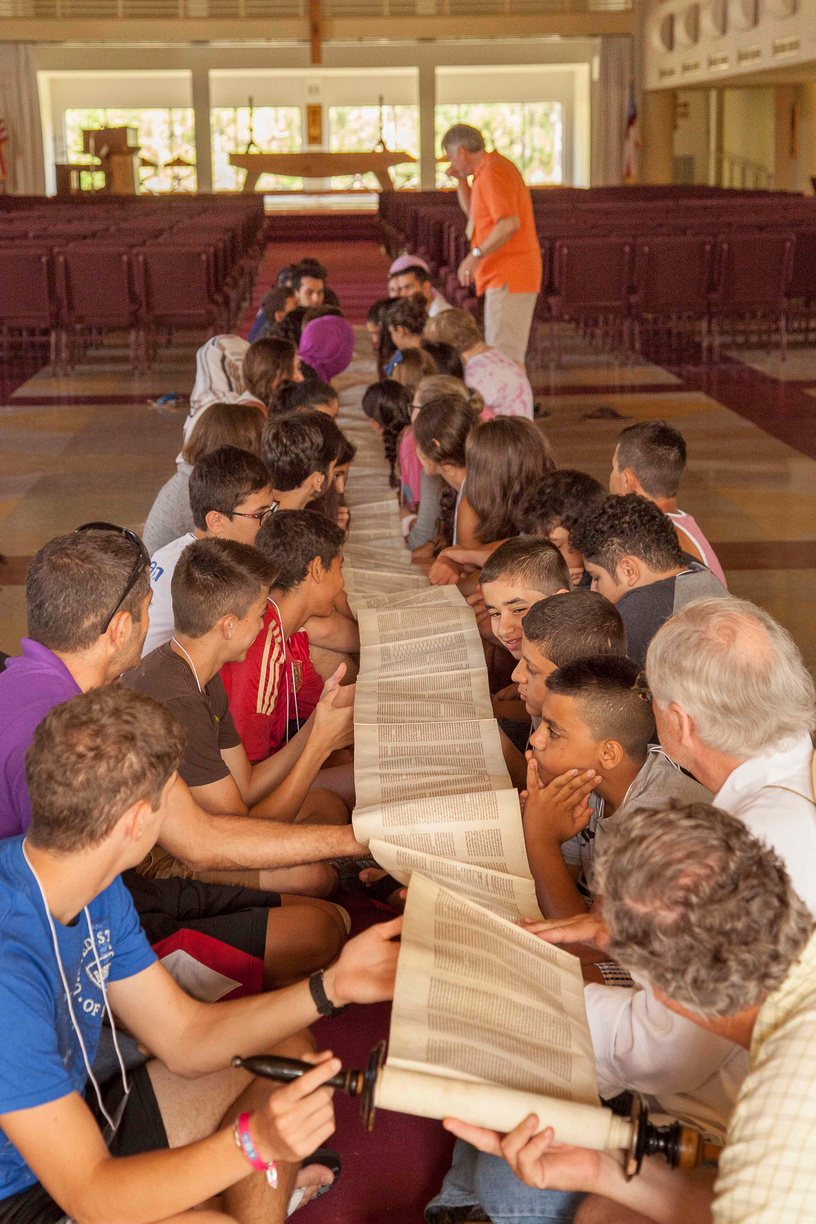
K4P08092014-3881-(ZF-3378-29602-1-001)This Friday night is our second “Welcome Shabbat” of the summer. Please join us and bring friends to our Sabbath service that promises to warm your heart and fill you with a sense of hope during this time of tension and violence in the Middle East as we welcome a group of teens from Israel and the Palestinian territories. These teens will grace us with their stories after having spent the week at an international peace camp called “Kids-4-Peace”.

This past Saturday, I had the privilege of joining this amazing group of teens at Camp Allen as the rabbi for the day. I was truly encouraged as these brave souls committed themselves to learning from each other despite the ongoing context of hatred and violence that have become so central to their daily lives.

Bring friends to services to spread a message of hope, and learn about this groundbreaking camp and how it strives to build bridges of peace by planting seeds of trust and understanding in the next generation of leadership.

Pitching Our Tent for All Who Wish to Enter

Over the course of the past year, our congregation has been actively engaged in a city-wide
effort to develop new strategies to engage the broader Jewish community. This project,
sponsored by the Jewish Federation of Greater Houston is called, Big Tent Judaism. This
approach to Jewish engagement draws from the values and vision of our Biblical forbearers
whose idea of an open tent has become an ideal a model for Jewish hospitality.

In direct contrast to the “members only” model which has dominated congregational life for decades, the “big tent” approach strives to engage everyone who may be interested in our programs regardless of formal affiliation. To that end, we have expanded our congregational reach by seeking to actively engage new comers, proactively follow-up with those who attend our services and programs, and seek ways to lower any obstacles that people may perceive regarding participation. Like a tent which is open on four sides, we are actively seeking ways to
welcome all who enter our space.

One of the most successful programs we have developed has been for the youngest members of the Jewish community. Through Tot Shabbat and Torah Tots, families with very young children have had the opportunity to be a part of our community on an ongoing basis. These programs are open to all who have young children, and over the course of a year, we have broadened our ability to develop relationships and strengthen bonds of community. In the coming year, we intend to build on our successes.

Other programs that have experienced remarkable success regardless of membership include our monthly book club, interest group, sup and swap and knitsvah group gatherings. Each of these adult activities has generated steady interest and ongoing participation. Members are encouraged to bring friends, and as a result, each respective community has grown with time.
In the month of August, we intend to open the HCRJ “tent” on a grand scale as we have set aside two very special Sabbath services designed to welcome all who may have been curious about our congregation. Each of these services is described in detail on page 4.

As we prepare to begin a new Religious School Calendar year and as we begin to consider our High Holy Day plans, please consider ways that you can serve as an ambassador of HCRJ. If you know people in your circles of friends and family who may be searching for a spiritual home, invite them to join you for services or a program.

We are proud of what we have to offer. Help us open the tent wide to all who wish to be a part of our congregational family.

July 23, 2014 (Israel Talking Points)

The name of this week’s Torah portion, Mas-ei, means “journeys.” This chapter in the Book of Numbers addresses some of the challenges the people of Israel take as they wander through the wilderness.

In our world today, navigating the complexities facing our people can often feel like being lost in the wilderness. With the escalation of the war between Gaza and Israel and with the resurgence of mob driven anti-Semitism in Europe, we are often pressed by coworkers, acquaintances and friends on what we think and believe is going on. While most of us do our best to represent our faith and heritage to the general public, our knowledge is often very limited and we can find ourselves wandering through assumptions we make based on incomplete information.

I personally continue to struggle to find the best navigation tools as the media and social media is woefully partial on all sides. As Jews, however, I do believe there are a few central elements we can continue to hold as central to our communal understanding of the wilderness ahead.

First and foremost in every conversation we have, it is extremely important to express the paramount value of human life. We mourn for the loss of all life. In war the loss of life, especially those who are the innocent victims of conflict, is tragic.

Secondly, we recognize the horrible conditions under which the Palestinian people continue to live. There is a humanitarian crisis which needs to be addressed, but this crisis is not the fault of Israel. Any argument that blames this crisis entirely on the Israeli blockades needs to be refuted. These blockades have been put in place specifically because weapons are consistently smuggled into Gaza through the shipment of everyday supplies.

Thirdly, it is important to emphasize that Israel ONLY wants peace. When people criticize Israel for its military actions, it is important to emphasize that Israel has the right to defend herself and secure its borders like any other country in the world.

Finally, Israel would like nothing more than to exist in a region where it could put down its weapons for good – but that is not the case. If Israel were to put down its weapons and declare unilaterally that it would no longer defend itself, Israel would be annihilated immediately. In contrast, if Hamas unilaterally laid down its weapons and never shot another rocket or committed another act of terror – the result would be peace.

These arguments may be over simplified, but they are rooted in the core principles we hold to be true. While ongoing diligent research is essential to each of our dialogues and arguments in days ahead, these statements can help us navigate the complex political wilderness into which we have been thrown.

L’Shalom — Steve

July 16, 2014 (Interfaith Iftar)

Last Friday night after Shabbat services, members of HCRJ caravanned to a mosque in Katy to participate in a brief program entitled, Ritual Fasting in the Abrahamic Faiths. After a wonderful program with an imam and two reverends, we shared in a joyous Iftar (break-the-fast). One thing we all learned that night was that fasting plays a central role in each of our faiths.

In Judaism, the discipline of fasting serves two main functions. Fasts are used to focus our attention (as is done on Yom Kippur) as well as commemorate tragedies (which was the purpose of a little known fast that took place in the Jewish world yesterday).

Yesterday was a Jewish fast day called, The Fast of Tammuz, which commemorates the breaching of Jerusalem’s walls by the Babylonians in 586 BCE. While very few Reform Jews observe this solemn day, this year groups of Jews around the world sought to find new meaning and new significance in their fasting by doing so in solidarity with the Muslims in their communities.

Here in Houston, Jews and Muslims broke their fasts together at St. Paul’s United Methodist Church as a public demonstration of good faith and brotherhood. This united effort represents an important symbolic effort in an ongoing commitment to building bridges of trust and understanding despite the war between Israel and Gaza.

Join us tomorrow night at HCRJ as we continue in these good faith efforts as we host an interfaith Iftar. Click Here For Details.

We may not be able to bring peace to the Middle East, but publicly embracing interfaith spiritual events like these help build bridges of trust and understanding between our religious communities here in Houston. These bridges may be a very small part of the picture, but they constitute an important step in in the right direction.


L’Shalom — Steve

Previous Next