
August 10, 2022

Dear Friends,

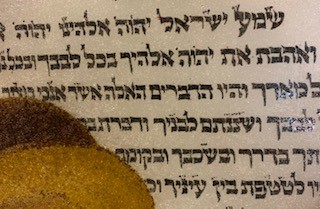
The image above comes from the glass panels that adorn the Oppenheimer Foyer as you enter our building. These words are familiar to every Jew, and they come from this week’s Torah portion.

Shema Yisrael, Adonai Eloheinu, Adonai Echad.
Hear, O Israel, the Eternal is our God, the Eternal God is One.

This six-word phrase is one of the most important texts in Jewish life. Traditionally, the Shema is recited twice a day. It provides us with a sense of comfort before we go to sleep at night, establishes a sacred mindset when we wake up in the morning. In reciting these words daily, the Shema helps us connect with Jews around the globe and across generations.

This simple statement of faith also serves to remind us that there is an eternal source of power and energy that pulses through all existence. This divine force links all people and all creation to a single source, which (in our severely fragmented world) is often overlooked.

This past weekend, I had the privilege of joining an amazing group of teens from the Holy Land (the preferred term used by the participants of Jerusalem Peacebuilders/Peace Camp). These remarkable campers spent two weeks working hard on building bridges toward peace. At the core of their work is a mutual recognition of the fact that while Jews, Christians and Muslims may have differing beliefs, God is at the heart of our shared endeavors.

During my brief time at this camp each year, I am inspired, encouraged, and humbled as these brave souls commit themselves to learning from each other. They refuse to allow hatred and violence squelch their hopes for peace, and they refuse to allow religious differences divide them. For these bold young leaders, the Shema’s declaration of unity is a clarion call for all human beings.

These campers will be joining us this Friday night for Shabbat Services. They will share their experiences and maybe even sing a song for us.  Bring friends to services to spread a message of hope and learn about this groundbreaking camp and how it strives to build bridges of peace by planting seeds of trust and understanding in the next generation of leadership.

L’Shalom,
Steve
August 3, 2022

Dear Friends,

This week, we begin the Book of Deuteronomy. This final book of the Torah is an oration by Moses, who is recounting the entire story of the Israelites from the Exodus from Egypt to the precipice of the Promised Land.  According to our tradition, this oration was delivered in a single day to the entire community, and for the sages, the fact that Moses was heard and understood by all was nothing short of a miracle.  In contemplating the nature of this miracle, we can imagine two scenarios.  Both of which focus on the power of words.

The first scenario argues that a miracle enabled everyone to hear and understand the words of Moses in the same way. This scenario suggests that the language and the delivery of these words were so clear that all who heard them fully understood exactly what to do.

The second scenario suggests that the miracle lay not in the clarity of the message but, rather, in its ambiguity. Here, a miracle is reflected in that fact that a single, Jewish people could evolve from diverse opinions.  This scenario suggests that the miracle was not in the moment at the mountain but rather in the passion of a people would conceptually return to that moment as a sacred reference point for all time.

The values and the knowledge we gain from Torah is the result of study, interpretation, dialogue and personal interactions with the text. The power of these ancient teaching comes from both the clarity and the ambiguity embodied in the sacred words.

As liberal Jews living in a modern world, we read the same words that our ancestors heard thousands of years ago, but like the Israelites in our story, the messages we draw from the text are not monolithic.  In fact, they are as diverse and complex as the multitudes which stood at the mountain.

The fact that we, like our ancestors, can hear the same words, draw different conclusions and still maintain a sense of peoplehood is something we should recognize as sacred and miraculous.  May this miracle of our people ever remain a reality as we – like our ancestors long ago – continue to hear the words of Torah in our own unique ways and translate them into the fabric of our lives.

L’Shalom,
​​​​​​​Steve

July 27, 2022

Rabbi on the Road – Finale

Dear Friends,

L’Shalom,
Steve

July 20, 2022

Rabbi on the Road – Vlogs #1-5

Dear Friends,

L’Shalom,
Steve

July 13, 2022

Dear Friends,

Every so often, a Jewish holiday pops up on the calendar, and you have no idea what it is. This weekend has one such holiday. It is called the Fast of the Seventeenth of Tammuz (this year it falls on July 16).

The Fast of Tammuz is a Jewish fast day commemorating the breach of the walls of Jerusalem by the Romans before the destruction of the Second Temple in 70CE.  For observant Jews around the world, the Fast of Tammuz marks the beginning of the three-week period of mourning leading up to Tisha B’Av (which is the fast day commemorating the destruction of the Temple three weeks later on the 9th day of Av).

During this three-week period some people abstain from listening to music, getting married, and cutting their hair. In contrast to Tisha B’Av and Yom Kippur, this fast begins at sunrise and ends at sunset.

It is not surprising that most liberal Jews do not observe the Fast of Tammuz and do not even know that it exists. So, what might we make of this obscure observance as Reform Jews today?

One connection that has contemporary significance is rooted in a teaching in the Mishna. According to a rabbinic legend, the walls of Jerusalem were broken on the seventeenth of Tammuz because it was the date on which Moses had smashed the Ten Commandments in response to the sin of the Golden Calf. Thus, the Fast of Tammuz might serve as an invitation to contemplate how our misguided actions can often cause a rupture or a breach in our relationships with each other, with our community, and with God.

L’Shalom,
Steve

July 6, 2022

Dear Friends,

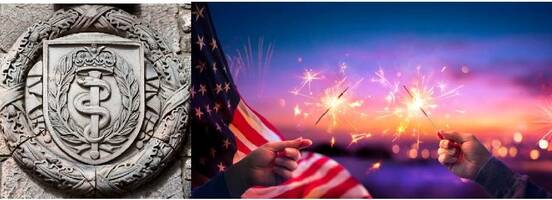
For those who may be familiar with the image of the snake and rod symbol found in the medical profession, it is based on something found in this week’s Torah portion. In our parasha this week, we are presented with one of the strangest rituals in the entire Torah. God instructs Moses to make a copper serpent and mount it on a pole.  All who may have been bitten by poisonous snakes (which by the way God had placed in the camp to punish the people for rebelling) could heal themselves by looking at this copper snake.

Frankly, snake idols that heal seem very out of place in our faith, but since it is written in the Torah, it invites us to consider lessons for today.

The great Torah scholar, Rabbi Samson Raphael Hirsch, suggests that over time our ancestors had grown complacent regarding their freedom and security.  By introducing them to attacks from poisonous snakes (which reminded them of danger) and then allowing them to find healing and safety by simply looking at a copper serpent, Rabbi Hirsch suggests that God is trying to generate fear and reverence at the same time.

This story and its commentary may seem strange, but it seems oddly familiar. The use of symbols to invoke fear and awe at the same time are at the heart of much of the splendorous pageantry we shared two days ago. By using harmless rockets which explode with glorious light, our fireworks on the Fourth of July employ shock and awe to help celebrate our freedom and our independence.

Like the copper serpent was for our people in the wilderness, fireworks have become a way to use dangerous imagery for the purpose of a lesson in a spectacular way. Happy belated Fourth of July!

L’Shalom,
Steve

June 29, 2022


Checking In From Greene Family Camp

Dear Friends,

L’Shalom,
Steve

June 22, 2022

Dear Friends,

In our Torah portion this week, we are presented with two biblical characters who are archetypes of moral courage. Joshua and Caleb are two spies among a company of twelve. The task each of these spies has been given is to assess the livability of the Promised Land. Ten of the spies return with reports that are filled with fear and trepidation, which generates extreme angst among the people.

Only Joshua and Caleb return with reports which are positive and optimistic. They also recognize the challenges ahead, but they believe that each challenge can be overcome with perseverance, collective strength, and faith.  While their opinions may constitute a minority, Joshua and Caleb are rewarded for their bold leadership, and because of their vision for the future, Joshua and Caleb become the only leaders in their generation who are granted the opportunity to enter the land.

Effective leadership demands generating confidence and hope. One of the most important qualities needed in the leaders we choose to follow is a capacity to generate hope in the face of fear. Life is filled with challenges and obstacles, and when our first reaction is fear and dread, our chances of moving beyond them is greatly diminished. If, however, we can ground our responses in optimism and hope, our chances of success increase exponentially.

This week the Torah provides a perfect model of such engagement, as it elevates and celebrates the optimistic leadership of Joshua and Caleb. Each of us has the capacity to embrace such a positive mindset. Whether it is through who we choose to lead us or how we choose to lead, when we approach the challenges that confront us with confidence and faith, we, like Joshua and Caleb, can look forward to entering the Promised Land.

L’Shalom,
Steve

June 15, 2022

Dear Friends,

Sunday is Juneteenth, and while it is not a Jewish holiday, it is a celebration of freedom that deserves recognition in our community. Juneteenth is the oldest known celebration honoring the end of slavery in the United States, and its origins are directly linked to Texas.

Juneteenth commemorates June 19, 1865 when Union General Gordon Granger led thousands of federal troops to Galveston to announce that both the Civil War and slavery had come to an end. In 1980, Texas became the first state to declare Juneteenth a holiday. Other states have followed, as the recognition of freedom and equal rights for all citizens is a cornerstone value of the United States.

In recognition of Juneteenth, selected readings and musical pieces will augment our Sabbath worship experience this Friday night at 6:30pm. May this Juneteenth be a celebration for all of us as we remind ourselves of the value and importance of freedom in the world.

L’Shalom,
Steve

June 8, 2022

Dear Friends,

The month of June is Pride Month. It is a time to open our hearts and our minds to the needs of the LGBTQ+ Community. Throughout the month of June, events are held across the globe to raise awareness, express solidarity and celebrate, but celebrating Pride cannot happen without acknowledging its roots.

Pride Month honors the Stonewall Uprising in Manhattan in 1969. At this point in history, “homosexual acts” were considered illegal across the country. Shamefully, raids on LGBTQ-inclusive spaces were very common. The resistance to a police raid on a gay bar in New York City later became known as the Stonewall Uprising. This uprising was a tipping point and from it emerged the gay liberation movement in the U.S. A year later, on June 28, 1970, the first Pride parade started at the Stonewall Inn. This became the impetus for a global movement that continues to elevate the LGBTQ+ community around the world.

Join us this Friday night for a special Shabbat service in the spirit of Pride Month. During this service, special mediations and musical pieces will shape our worship as we celebrate the LGBTQ+ community within our congregation and beyond.

L’Shalom,
Steve

Previous Next